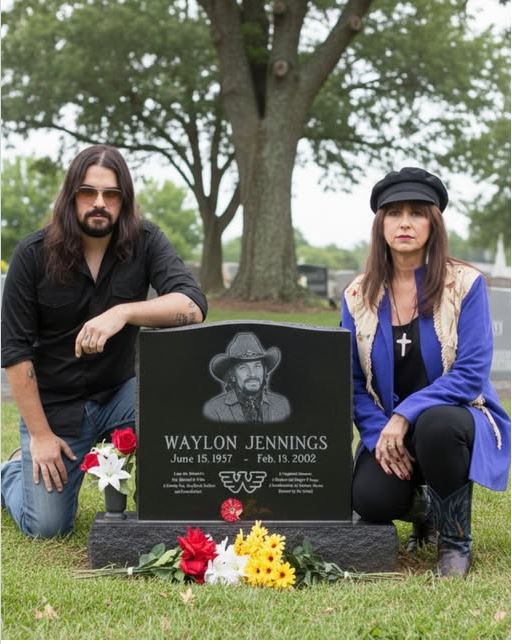
A Sacred Visit to Waylon’s Resting Place
On a quiet afternoon, Jessi Colter and her son Shooter Jennings made their way to the final resting place of Waylon Jennings, a man whose voice and music shaped the very soul of country music. They carried no instruments, no fanfare, and no stage lights. Instead, they brought the simplest and purest offering—flowers. Before the stone etched with Waylon’s face, mother and son knelt, their presence not just a tribute but an intimate conversation with memory itself.
It was here, in the silence, that their voices rose together. Jessi’s trembled with emotion, while Shooter’s rang out deep and steady. The harmony they created carried a weight far beyond words, blending as if Waylon himself were singing along just beyond the veil.
The Song That Bound Them Together
The melody they chose was no accident. “Good Hearted Woman”, a song forever tied to Waylon Jennings’s legacy, became the bridge between the living and the departed. This was not a performance for an audience—it was a conversation between a wife, a son, and the man whose influence continues to ripple through generations of country music lovers.
Every note carried the story of a family intertwined with music and faith. Jessi’s fragile yet unwavering tone carried the intimacy of decades shared, while Shooter’s grounded voice reflected both sonship and legacy. Together, they wove a moment that was less about remembrance and more about presence, as though Waylon was right there beside them, lending his timeless baritone to the chorus.
Waylon Jennings: A Legacy Beyond Music
Waylon Jennings was more than a country music legend. He was a husband, a father, a friend, and a pioneer of the Outlaw Country movement. His songs spoke of freedom, rebellion, and the raw honesty of human experience. Yet, for those closest to him, his greatest role was not the one celebrated under bright stage lights, but the one lived quietly at home—with his family.
When Jessi and Shooter sang by his grave, they reminded the world that behind every legend lies the human heart that beats within a family’s love. Waylon’s impact may have filled arenas, but it was in the quietest of moments—around kitchen tables, in private prayers, and by gravesides—that his spirit was most deeply felt.
The Spiritual Power of Music at Graveside
There is something profoundly spiritual about music at a graveside. The blending of voices with silence, the weight of memory, and the thinness of the veil between past and present create an atmosphere unlike any other. For Jessi and Shooter, this was not an act of mourning but an act of communion.
Their voices echoed into the still air, carrying not only the memory of Waylon’s music but also the shared grief, love, and faith that continue to bind them together. To those who have loved and lost, moments like this are universal—reminders that death cannot silence love, and that music has the power to carry us across divides that words alone cannot bridge.
“Good Hearted Woman”: The Song That Endures
The choice of “Good Hearted Woman” was poignant. Originally a song that celebrated devotion and resilience, it became in that moment a reflection of Jessi’s own journey. Through years of marriage, through the struggles and triumphs of Waylon’s career, she stood as a partner not just in life but in music.
Singing it again at his graveside was not a performance—it was a testimony. A reminder that music lives beyond death, and that love, when sung, has the power to keep memory alive.
Shooter Jennings: Carrying the Torch
Shooter Jennings, Waylon’s son, carries forward not only his father’s name but also his musical spirit. His deep and steady tone at the graveside was more than just harmony; it was the continuation of a family tradition. Where Jessi’s voice trembled with the emotion of decades, Shooter’s voice carried the strength of a new generation rooted in the past yet forging its own path.
Shooter’s career has never been about imitation but about honoring the foundation laid before him. Singing alongside his mother at Waylon’s grave was a moment where past, present, and future collided—a reminder that legacies are not static, but alive and breathing in the voices of those who carry them forward.
A Moment That Transcends Time
The beauty of that quiet afternoon was its simplicity. There were no crowds, no cameras, no stages—only the raw and unfiltered reality of family love expressed through music. In that moment, the Jennings family reminded the world that country music is not just about fame or charts; it is about heart, truth, and connection.
The tremble in Jessi’s voice, the steadiness in Shooter’s, and the silent presence of Waylon created a scene that transcended time. For those who love country music, it is moments like these that remind us why the genre matters—it is not just entertainment; it is a vessel for memory, faith, and the deepest human emotions.
Conclusion: Love, Legacy, and the Eternal Song
What happened on that quiet afternoon was more than a graveside visit. It was a sacred act of love, an intimate family tribute, and a reminder that music has the power to reach across eternity.
Waylon Jennings may rest beneath stone, but his voice continues in the trembling notes of Jessi, the deep tones of Shooter, and in every fan who still finds comfort in his songs. In the still air of that graveside, one truth became clear: love never dies, and music never fades.