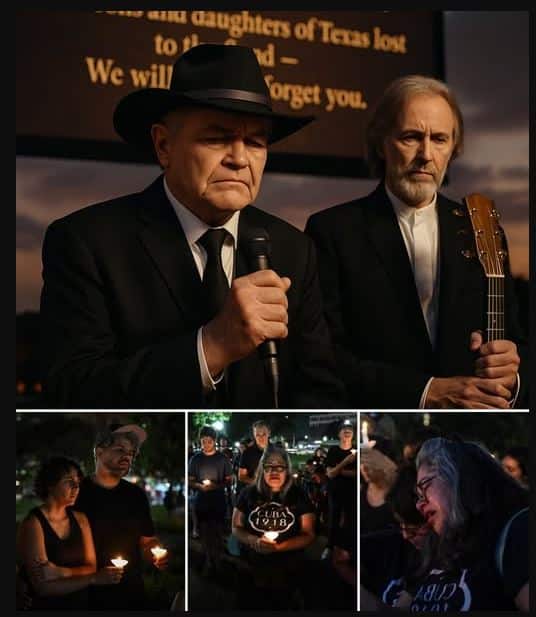
A Community United in Grief and Resilience
On the evening of July 12, 2025, the town of Kerrville, Texas, witnessed a gathering of remarkable significance. Thousands of residents, families, volunteers, and visitors convened under the shadow of a recent historic flood, an event that had devastated the region, claiming at least 120 lives in Kerr County and leaving a trail of destruction across neighborhoods. This assembly was not simply a musical event; it was a memorial concert that offered the town a chance to mourn collectively, honor the victims, and demonstrate the resilience and unity of a community determined to rebuild.
As the stage lights suddenly dimmed, silence swept over the crowd. Micky Dolenz, aged 79 and the last surviving member of The Monkees, stepped forward. His rendition of “Last Train to Clarksville” resonated across the assembled audience, carrying the weight of grief, hope, and intergenerational connection. The performance was more than a tribute—it was a healing moment, a shared acknowledgment of both loss and survival, a powerful reminder that even in the darkest times, music can bridge human hearts.
The July 4 Flood: Unprecedented Devastation
The flood that struck on July 4, 2025, was a calamity of unparalleled force. In the early pre-dawn hours, towns like Ingram were oblivious to the destructive torrent rushing toward them. By sunrise, homes were obliterated, families were separated, and entire communities were left scrambling to survive. Among those who endured were Libby and Doug Fuller, who lost all material possessions but remained together. Libby, demonstrating extraordinary resilience, returned to work preparing meals for first responders the very next day, while Doug’s father joined cleanup efforts immediately. Volunteers tirelessly worked alongside emergency personnel, navigating debris-strewn streets to help restore order and safety. This collective effort exemplified the strength and perseverance of Kerrville’s residents.
Memorializing Lives Lost: The River of Angels
In the wake of the flood, community memorials became focal points for collective mourning. Along Water Street, a chain-link fence known as the “River of Angels” transformed into a tribute covered with flowers, candles, photographs, and personal mementos. This memorial honored lives lost, including Julian Ryan, who died trying to save his family, and Richard “Dick” Eastland, the director of Camp Mystic, who perished while safeguarding campers. Around 300 people gathered for a vigil at the site, accompanied by faith leaders and survivors, emphasizing the community’s shared grief and enduring solidarity. The River of Angels emerged as a poignant symbol of Kerrville’s capacity to mourn collectively while drawing strength from shared memories and experiences.
Community Response and Recovery Efforts
In the aftermath of the flood, Kerrville’s response reflected both immediate action and long-term planning. Residents promptly applied for federal and state aid, met deadlines for debris removal, and supported local businesses affected by the disaster. Musicians organized benefit concerts to fund recovery efforts, demonstrating how culture and art can serve as a lifeline for healing. Plans were also underway to reopen Camp Mystic with enhanced safety protocols, ensuring that future generations would continue to enjoy the facility under improved safety measures. The Heaven’s 27 Safety Act, allocating $240 million for disaster relief and upgraded warning systems, further reinforced the town’s commitment to resilience, safety, and preparedness.
A Night of Healing and Hope
The memorial concert on July 12 was more than an event—it was a testament to the town’s indomitable spirit. From the powerful voice of Micky Dolenz to the quiet solidarity of the audience, the evening served as a reminder that Kerrville’s strength lies in its people. Music became a medium for collective reflection, a space where sorrow could coexist with hope. It highlighted that community, empathy, and shared experiences are fundamental to overcoming tragedy.
Even amid destruction, Kerrville demonstrated that human connection, resilience, and unwavering courage can restore hope. The memorial concert not only honored those lost but also reinforced the commitment of the community to rebuild stronger, safer, and more united than before. It is a shining example of how small towns can embody extraordinary strength, and how music and remembrance can serve as catalysts for healing, solidarity, and renewal.
The Lasting Impact of the Kerrville Memorial Concert
In a region forever marked by disaster, the July 12 memorial concert became a cornerstone of Kerrville’s recovery story. The event illustrated the power of community-led healing, providing a platform for survivors, volunteers, and neighbors to come together. Through shared grief, the town found shared strength, resilience, and determination. The memorial concert, the River of Angels, and ongoing recovery initiatives collectively represent Kerrville’s spirit of hope and perseverance, serving as an inspiring example for other communities facing adversity.
Even as the waters recede and rebuilding continues, Kerrville’s residents have proven that unity, compassion, and courage remain unshaken. In the face of devastation, this town stands as a testament to the enduring power of community, music, and remembrance. Kerrville’s story is one of tragedy transformed into strength, grief reshaped into hope, and a community determined to move forward, together.
https://youtu.be/wklqvw0JaNA